Book Appointment Now

Raised Edge Countertop: What the Eased Edge Is and When It Fits
A raised edge countertop, in the way most shoppers use the phrase, is an eased edge: a straight, flat edge face with corners rounded by about 1/8 inch (3 mm). It is not a backsplash lip or a counter built at a taller height. The term describes a slightly softened profile that fabricators also call a pencil edge. The profile looks crisp and minimalist, yet it feels far gentler than a sharp square edge. Softened corners reduce chipping and make bumps less harsh. Because the profile trims only a tiny section of the slab, it also keeps nearly all usable surface intact.
The eased edge is the simplest finished profile for stone, which makes it a cost-effective and familiar choice for granite, marble and quartz. From across a room it reads like a plain square edge, so it suits modern, transitional and high-traffic kitchens and bathrooms. Its main distinction from a true square edge is durability and comfort, since sharp, crisp corners are more prone to chipping. The sections below show how it compares with other profiles, where it fits best and how to choose between them.
What Is an Eased Edge Countertop?
An eased edge countertop has a flat vertical face, a flat top and corners softened to a radius of about 1/8 inch (3 mm). That small rounding removes the razor-sharp arris of a cut slab without changing the overall shape of the edge. The result still looks straight and clean, but it feels smoother under a hand or forearm when you lean on the counter. Think of it as a square edge that has been lightly sanded rather than a new, decorative shape.
You may see the same profile listed as a pencil edge or a 1/8 inch radius edge on fabrication quotes. A pencil edge is rounded to a 1/8 inch radius, the same as an eased edge, and at least one fabricator treats the two as identical. Quote names vary by trade, so the label matters less than the measurement. An edge of about 1/8 inch (3 mm) is an eased edge regardless of what the paperwork calls it.
It is the simplest finished edge available for stone, and that simplicity brings practical advantages. Very little material is removed, so the usable surface is maximized and the slab keeps its full footprint. Fabrication takes minimal shaping, which keeps labor modest, and the plain face has no grooves or ornament to complicate cleaning. These traits explain why it is so common across kitchens, vanities and bathrooms of many styles.
Is a Raised Edge the Same as an Eased Edge?
Usually yes: shoppers who search for a raised edge countertop typically mean an eased or pencil edge, a flat edge with lightly rounded corners. The phrase is informal rather than a standard trade term, so a fabricator is more likely to quote it as eased, pencil or 1/8 inch radius. If you ask for a raised edge, the shop may need to clarify which profile you have in mind. Naming the radius removes that guesswork.
Other profiles can also be described as raised, and they are different products altogether. A raised-height counter sits higher off the floor, while a lipped or built-up edge adds a raised rim along the outside. A built-up thickness profile with a raised outside edge, not mitered, appears more often on stainless steel than on stone. None of these match the subtle softening of an eased corner, so treat them as separate topics.
Confirm the profile name and radius on the fabrication quote before approving anything. Because quote names vary by trade, asking for the radius is the surest way to verify what you are buying. An eased edge should show about 1/8 inch (3 mm), which keeps it distinct from larger roundovers and decorative shapes. If the number differs, ask the fabricator to explain the profile and show you a sample.
Eased Edge vs. Square Edge
An eased edge and a square edge look nearly identical from a distance, but the eased edge has softened corners while a true square edge has sharp, crisp ones. That difference is invisible across the room and obvious in the hand. Eased corners feel more comfortable, resist chipping better and cause less injury when someone bumps them. The table summarizes the contrasts on the criteria that matter most in daily use.
A square edge has its own appeal, because its hard lines can look architectural and precise. The tradeoff is that sharp corners concentrate impact, so a dropped pot or a swinging chair can chip them more easily. Eased corners spread that force over a slightly rounded surface, which makes chips less likely and less severe. For families, that quiet protection is usually worth more than the marginal crispness of a razor edge.
Cleaning and cost are close between the two, since both are plain profiles without grooves or decoration. What separates them is touch and risk, along with how the edge looks up close, where the soft highlight on an eased corner becomes visible. Both suit modern design, and the eased version simply keeps that clean line while removing the hazard. If you love a razor-sharp look, ask to see both samples side by side before deciding.
| Feature | Eased edge | Square edge |
|---|---|---|
| Corner | Rounded about 1/8 inch | Sharp, crisp |
| Chip risk | Lower | Higher |
| Comfort | Softer | Harsher |
| Look | Clean, minimal | Crisp, angular |
Benefits and Drawbacks of Eased Edge Countertops
Eased edges are safe, low-maintenance, cost-effective and versatile, with one real drawback: a plain look that offers little decorative character. They have no grooves or flourishes to trap debris, so they wipe clean easily and suit busy kitchens and bathrooms. Because so little is trimmed from the slab, you also keep more usable countertop space. The simple profile blends with most cabinet and slab choices, which is why it is considered so versatile.
The drawbacks are modest but worth weighing. The corner is only slightly curved, so it is still pointed enough to bump young children. The profile is also understated, which is a poor match for ornate or traditional designs where a carved edge adds richness. If you want the edge to be a feature, a more decorative profile will serve you better. If you prefer calm lines and practical performance, the eased edge fits well.
- Safe, softened corners
- Easy to clean
- Cost-effective
- Plain, minimal character
Which Materials Work With an Eased Edge?
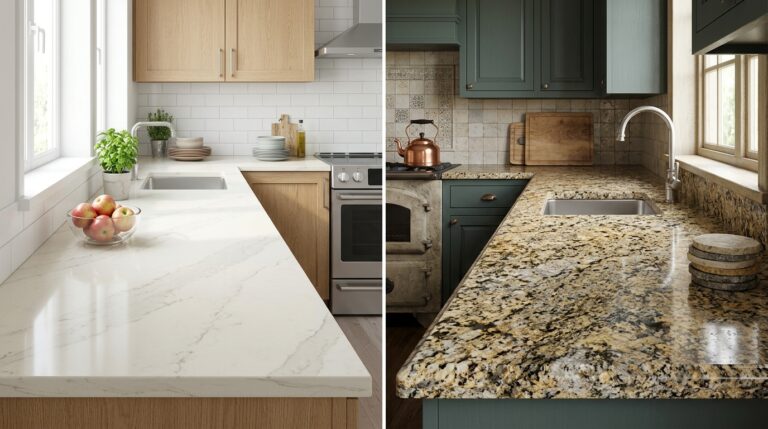
An eased edge works with granite, marble and quartz, including engineered brands, as well as other natural stone and solid surfaces. Granite takes it especially well, and the pairing is a common fabrication combination. Laminate is different because its edge is formed rather than cut from stone, so edge options are more limited. For stone and quartz, the profile is a standard, reliable choice.
Material behavior influences how much the eased corner matters. Some natural stones, such as certain quartzite and marble, are more brittle than others. On those, softened corners matter more, since sharp edges are likelier to chip. A hard, dense slab tolerates a sharper edge better, yet eased corners still add a margin of protection. Ask your fabricator how your specific slab behaves when shaped.
Slab thickness changes the effect. Thicker slabs feel substantial, and the eased edge softens that heft while protecting against chipping. Standard thickness with an eased edge gives a sleek, slim look. Either way, the profile adapts without adding visual fuss. Choose thickness for the character you want, then let the eased corner handle the practical details.
| Material | Eased edge note |
|---|---|
| Granite | Takes it well |
| Quartz | Pairs well |
| Marble, quartzite | Some brittle; ease matters |
How Does an Eased Edge Compare With Other Countertop Edges?
The eased edge is the simplest of the common profiles, so it takes the least fabrication work and sits in the standard tier. Main options include square, eased, pencil, beveled, bullnose, ogee, Dupont, mitered and waterfall. They differ in look, chip exposure, cleaning effort, cost and style fit. The table gives a general comparison, with cost tiers described as relative positions rather than prices.
Decorative profiles add shaping and labor. An ogee or mitered edge takes more work and costs more than an eased edge. Waterfall edges, which carry the slab down the side of a cabinet, are a premium statement rather than a standard choice. Bullnose and beveled edges sit between, adding curves or angles that need extra shaping. Square and eased edges remain the plainest, with eased adding comfort.
Fit matters as much as cost. Plain profiles suit modern and transitional rooms, while ornate shapes pair with traditional woodwork. A detailed edge on a minimal kitchen can feel out of place, and a plain edge on ornate cabinets can look underdressed. The eased edge works as a quiet default because it rarely clashes. The next two subsections look closely at chipping and cleaning, where profiles differ most.
| Edge | Chip risk | Cleaning | Style | Cost tier |
|---|---|---|---|---|
| Eased | Low | Easy | Modern | Standard |
| Ogee | Higher | Harder | Traditional | Premium |
Chip Resistance: Which Edges Hold Up Best?
Eased edges hold up well because they have no sharp corners, and they are less likely to chip than an ogee or full bullnose. Rounded profiles distribute impact across a surface, while sharp corners concentrate force at a point. A knock that would chip a crisp square corner is more likely to glance off a softened one. That makes the eased edge durable for everyday use.
Detail pockets increase exposure. An ogee has curves, steps and thin points of stone that can catch an impact, so it is more vulnerable. A full bullnose is more rounded, but it can expose more of the slab to swinging objects. A bevel has an angled cut, and its corners may be sharper than an eased corner. Square edges are the most exposed, since their sharp corners take impact directly.
Household conditions change how much this matters. Busy kitchens see dropped pans, moving stools and constant contact. Families with small children benefit from eased or rounded edges over a sharp square, which are kinder to bumps. A fully rounded bullnose offers the gentlest touch, while an eased edge strikes a balance of protection and a clean line. Remember that a pointed corner can still bump a child.
Material still counts, because a brittle stone chips more easily than a hard one. On marble or certain quartzite, an eased corner is a sensible baseline, and nothing makes any edge immune from damage. A hard blow can chip any stone, so treat the profile as risk reduction rather than a guarantee. Sensible care and a fabricator’s advice finish the job.
Cleaning: Why Simple Edges Wipe Clean Faster
Simple edges wipe clean faster because a smooth eased profile has no grooves or steps to hold debris. A cloth can pass along the edge in one motion and pick up crumbs and splashes. Dirt and crumbs do not build up in crevices, so routine wiping keeps the edge looking tidy. This makes upkeep quick in a busy kitchen.
Detailed profiles take more effort. Ogee and Dupont edges have curves, grooves and steps that gather residue. Skip these profiles if you want a one-pass wipe, because those recesses need extra cleaning with a cloth or soft brush. Grease and food particles settle into the tight corners where a flat cloth cannot reach. The more detail an edge has, the more attention it demands.
Maintenance expectations should shape the choice, since you will clean the edge far more often than you will admire it. If your kitchen sees heavy cooking, the plain eased face saves time every day. A decorative edge can still be a good choice when you value the look, as long as you accept the extra care. For low maintenance needs, the eased edge is the practical option.
How to Match an Eased Edge to Your Cabinet Style and Kitchen
An eased edge fits best with Shaker, slab-look and slim Shaker cabinets, as well as transitional, modern and minimalist kitchens. Eased and pencil edges repeat the clean square line of Shaker-style doors without adding a sharp corner. Half bullnose is another suitable option if you want slightly more softness. The idea is to echo the cabinetry rather than compete with it.
It is a poorer fit for raised-panel traditional cabinets, which suit ogee, full bullnose or Dupont edges. An ogee has a decorative S-curve that suits traditional kitchens with detailed woodwork. A plain edge beside carved doors can feel flat and unfinished. In those rooms, a profile with some shape usually completes the look.
Small kitchens benefit from simple edges, which keep lines clean and visual weight low. A heavily profiled edge draws attention and can make a compact room feel busy. The eased edge keeps the surface calm so the room feels more open. Use the list below as a quick match guide.
- Best: Shaker, slim Shaker, modern, transitional
- Poor: raised-panel traditional
Where Eased Edges Are Commonly Used
Eased edges are common on kitchen perimeters and islands, bathroom vanities and high-traffic family spaces, especially in modern and transitional designs. They also work as a quiet contrast, paired with thick slabs or with waterfall or mitered islands. A plain perimeter lets a dramatic island stand out. That balance is a favorite among designers.
In bathrooms, the eased edge preserves the countertop space needed for toiletries. A simple edge saves space and creates a clean line in small rooms. Because little material is trimmed, every inch of the top stays usable. That practicality is why vanities and compact kitchens rely on it.
How Much Does an Eased Edge Cost?
An eased edge is typically a standard or included edge, while premium edges add fabrication labor and cost. Because it is the simplest profile, it takes the least work to fabricate, with less shaping and labor. One quartz cost guide cites eased edges at $5 to $30 per foot, and some standard edges are included in the price. Actual pricing depends on your fabricator and project.
Several factors drive edge cost: profile complexity, linear feet, material hardness, thickness and mitering. Each edge appears as its own line on the quote, so you can see its price before fabrication starts. Ask for line items and compare profiles directly, rather than relying on general estimates. Decorative and mitered edges will usually add more than an eased one.
| Cost driver | Effect |
|---|---|
| Complexity | More labor |
| Linear feet | Scales total |
| Mitering | Higher |
How to Choose a Countertop Edge in 4 Steps
Choose a countertop edge in four steps: match your design style, weigh household use, check material compatibility, then compare cost and view a physical sample. First, look at your cabinets and decide whether the room is modern, transitional or traditional. Second, consider chip risk and who uses the space, including children. Third, confirm that your stone or quartz works with the profile, and fourth, compare quoted prices and handle a sample.
Common mistakes include judging from photos alone and ignoring slab thickness. Photos hide how sharp or soft a corner feels in the hand. Thickness changes the proportions of any profile, so a sample should match your slab. Compare the edge sample next to a cabinet door before choosing, so you can judge scale and style together. Because each edge is its own quote line, you can see the price and choice before fabrication.
If you are unsure, the eased edge is a safe starting point: simple, durable, easy to clean and economical. It rarely clashes with cabinets, and it protects corners without adding decoration. Move to a decorative profile only when the style truly calls for it. Then confirm the profile name and radius on the quote.
- Match design style
- Weigh use and chip risk
- Check material
- Compare cost, see sample