Book Appointment Now

Beveled Edge Countertop: What It Is, How It Looks and When to Choose It
Understand how beveled countertop edges look, how they differ from other profiles, and when this finish makes sense for your kitchen.
A beveled edge countertop has a flat, angled cut, typically at 45 degrees, along the top corner of the slab. That cut forms a crisp transition between the horizontal work surface and the vertical face. The profile leaves a narrow flat surface before the face drops straight down. Because the angled plane catches light differently from the top, it adds depth and a subtle shadow line without a heavy sculpted look.
A bevel sits between a minimal eased edge and ornate profiles such as ogee or bullnose. It offers more definition than a barely softened corner, yet avoids the heavy curves of decorative styles. That balance lets it fit modern, transitional and traditional interiors. The visual result depends mostly on bevel width and the stone’s color and pattern, so the same cut can look quite different from one slab to the next.
What Is a Beveled Edge Countertop?
A beveled edge countertop is one whose top edge has been cut at an angle, leaving a flat, slanted face with crisp lines instead of a rounded curve. The bevel is typically 1/4 to 1/2 inch wide, so it reads as a clean geometric step between the top surface and the vertical side of the counter.
Compared with rounded profiles, a bevel keeps a defined corner where the angled face meets the top and side, while a curve blends everything into one soft surface. A double bevel adds a second cut along the bottom edge. The Hollywood bevel is a related profile that slopes gently and finishes with a rounded bottom.
What Does a Beveled Edge Countertop Look Like?
A beveled edge looks like a thin angled band running around the counter’s perimeter, framed by a crisp line on top and another where the slope meets the face. The slanted surface catches light at a different angle than the flat top, which creates a geometric transition rather than a single uninterrupted plane.
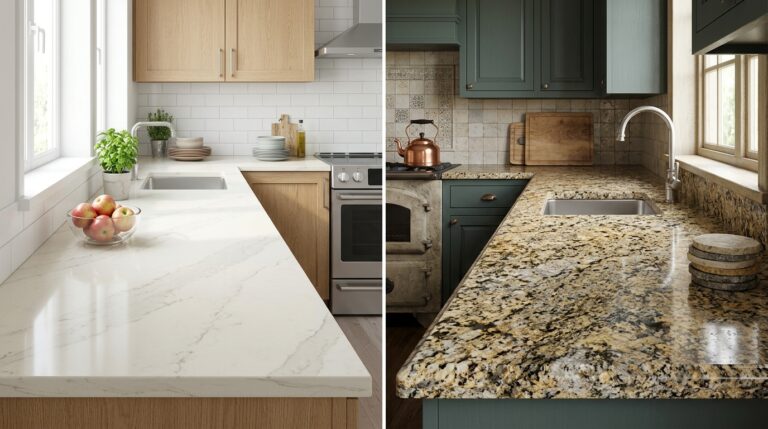
Shadows and highlights along that band make the edge appear more detailed, and sometimes more substantial, than a simply eased corner would. Material changes the effect. On granite, quartz and marble, the stone’s color and veining determine whether the angled face blends in or stands out from the top.
Cabinetry also shapes the impression. Beside flat-panel doors, a narrow bevel reinforces a clean, contemporary look, while with traditional cabinetry a wider bevel feels more formal. Photos flatten these effects, so it helps to view physical samples under your own kitchen lighting before settling on a width.
Types of Beveled Edges
Beveled edges come in two main forms: a single bevel with one cut along the top, and a double bevel with cuts on both the top and bottom edges. Angle and width then decide whether the effect is subtle or decorative, since a narrow bevel reads quietly and a wider one becomes a feature.
The basic bevel is a single top cut at about 45 degrees. A double 1/4 bevel adds the same kind of cut to the bottom edge as well. Choosing between single and double is largely an aesthetic preference rather than a performance decision.
Matching the type to the setting keeps the result cohesive. Narrow bevels suit contemporary kitchens with simple lines, while wider or double bevels add detail that complements traditional rooms. The two subsections below look at the quarter-inch bevel and the double bevel individually.
| Type | Cut placement |
|---|---|
| Single bevel | Top edge, about 45 degrees |
| Double bevel | Top and bottom edges |
What Is a 1/4 Inch Beveled Edge?
A 1/4 inch beveled edge is a narrow angled cut about a quarter inch wide along the top edge of a countertop, giving a subtle, tidy accent. It sits at the slim end of the typical 1/4 to 1/2 inch range, so it defines the edge without drawing much attention to itself.
This size suits countertops and islands alike. On an island, where the edge is visible from several sides, the narrow bevel keeps the perimeter looking crisp and consistent.
Narrow or quarter bevels suit contemporary kitchens with flat cabinetry. The restrained angle echoes the plain door fronts and avoids competing with them.
Because the face is small, light and shadow play across it only lightly. Anyone wanting a more noticeable edge may prefer a wider bevel or a double cut. A fabricator can show sample widths so you can judge the difference in person.
What Is a Double Beveled Edge?
A double beveled edge has angled cuts along both the top and bottom edges of the countertop, sometimes creating stepped faces that add extra detail. The second cut gives the edge more visual weight than a single bevel, making it feel more substantial and slightly more formal.
That added detail leans traditional. Wider or double bevels work well in settings where a decorative edge fits the room, though the choice remains an aesthetic preference.
There are practical trade-offs. Two cuts mean more fabrication detail, and the extra angled surfaces create more crevices where crumbs and debris can collect. Regular wiping along each angle keeps the edge looking clean.
Eased vs. Beveled vs. Square Edge Countertops
Eased edges soften the corner slightly, beveled edges add a visible angled face, and square edges leave a sharp 90-degree corner. An eased edge typically has a 1/16 to 1/8 inch radius on the top corner. Square edges are the sharpest and most chip-prone, while a bevel’s angle reduces chipping risk compared with that sharp corner.
Choose eased for a minimal look and a bevel for more defined geometry. A bevel typically adds about $5 to $10 per linear foot over an eased edge. Cleaning is easiest on the plain profiles, since a bevel’s corner may need extra attention to keep debris out.
| Edge | Look | Corner |
|---|---|---|
| Square | Sharp, plain | Chip-prone |
| Eased | Minimal | Slightly softened |
| Beveled | Defined angle | Angled face |
Advantages and Drawbacks of a Beveled Edge
A beveled edge offers versatile style and better chip resistance than a sharp square corner, but it is less forgiving than rounded profiles and needs a little cleaning care. Its look works in modern, transitional and traditional kitchens, and the modest cost premium over an eased edge keeps it accessible.
The angle reduces chipping risk compared with a square corner, and a flat bevel tends to chip cleanly if it is struck. The face may also help guide spills away from the cabinetry, and its flat surface is straightforward to wipe.
The drawbacks involve the sharp transitions. The bevel-to-face junction can fracture irregularly, and softer stones may chip at those points. The corner crevice also needs attention so debris does not build up, so a bevel asks a bit more from you than a rounded edge.
Which Countertop Materials Work with a Beveled Edge?
A beveled edge suits materials that can be cut and polished precisely, including granite, quartz and marble. Quartz stands out for its strength and uniformity. That consistency helps produce clean, even angles, while color and veining in granite and marble change how the bevel looks, since the pattern interacts with the slanted face.
Laminate works differently. Its edge is a built-up wood substrate covered with matching laminate, so the shape comes from construction rather than stone fabrication. That process is a different craft from cutting and polishing stone, so ask which bevel options a laminate supplier actually offers.
Is a Beveled Edge Right for Your Kitchen?
A beveled edge is right for your kitchen if you want clean lines with more definition than an eased edge, without the heavy curves of traditional profiles. Weigh style, cabinetry, household use, tolerance for cleaning and budget, since a bevel adds a modest per-foot cost over eased.
Modern and transitional kitchens are the best fits, with wider or double bevels extending the look into traditional settings. The bevel leans modern, while the half-bullnose leans traditional. Narrow bevels pair especially well with flat cabinetry.
One limitation involves children. Households where kids lean on counters may prefer a half-bullnose, which offers durability that eased and beveled edges cannot match. Before deciding, review physical samples with a fabricator against your stone’s color and veining.
Other Edge Profiles to Compare with a Bevel
Beyond the bevel, common choices include half and full bullnose, ogee, mitered and waterfall edges, and cove profiles. Each differs in how ornate or modern it feels compared with a bevel. Comparing them clarifies whether you want crisp definition, soft curves or a decorative flourish.
Bullnose is the more child-friendly rounded profile, while the bevel offers sharper definition. Ogee combines concave and convex curves for a more decorative result. Mitered edges form an angled connection between horizontal and vertical sections, producing a sharp contemporary look.
In short, ogee is more ornate than a bevel, mitered and waterfall edges are more modern, and bullnose is softer. Seeing samples side by side helps you choose which character suits your cabinetry and stone.
- Bullnose: rounded, child-friendly
- Ogee: decorative curves
- Mitered: sharp, contemporary